How can we design robust community functions?
Microbes inhabit agricultural soils, crops, and human mucosal systems, shaping the flux of functionally important metabolites. Therefore, controlling their metabolic activities (functions) is crucial for the planet’s greenhouse gas emissions and human health. A major hurdle in applying microbial solutions at scale is the lack of functional consistency and robustness in real-world environments. This is because most microbial solution designs do not systematically account for the abiotic and biotic environments the microbes experience when deployed in nature (Lee et al., 2023). [Full publication: Google Scholar]
My research program addresses this lack of functional robustness, one of microbiome science’s greatest obstacles, as we integrate high-throughput metabolite measurements, modeling, machine learning, and synthetic biology to enable the design of robust microbiome function.
Vaginal microbiome engineering project
I am currently devising synthetic biology solutions to engineer the vaginal microbiome to treat Bacterial Vaginosis as a postdoctoral scholar at the University of Delaware, Chemical & Biomolecular Engineering, advised by Dr. Aditya Kunjapur and Dr. Jacques Ravel at the University of Maryland School of Medicine in Baltimore, Maryland.
Soil microbiome project: How do community function respond to environmental change?
Figure 1 in Lee et al., Nature, 2025 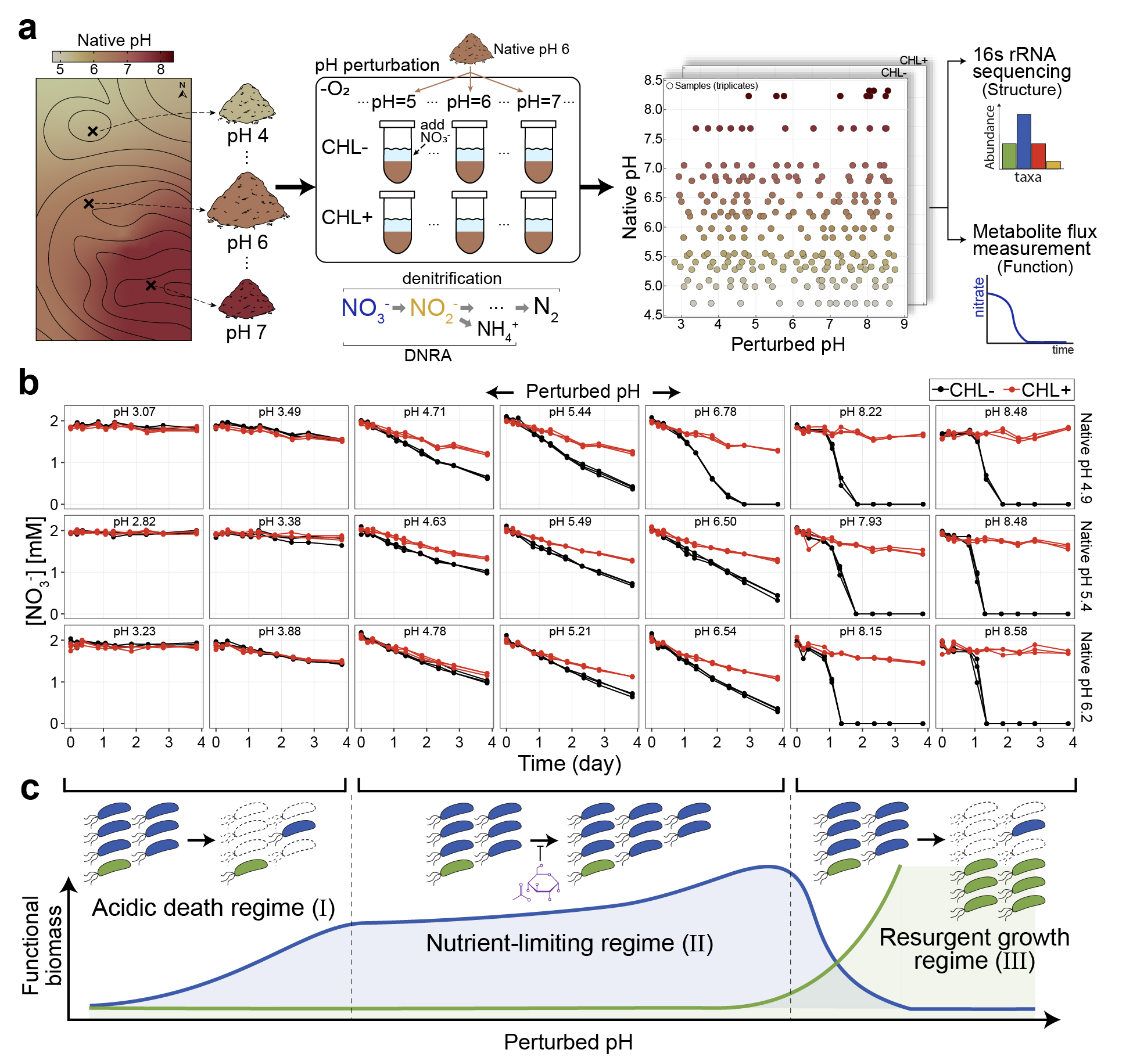
It is vital to understand how community function responds to abiotic environmental change, as a first step to design environmentally robust community functions. I investigated this during my Ph.D. at the University of Chicago, Ecology & Evolution Department, advised by Dr. Seppe Kuehn and Dr. Madhav Mani at Northwestern University. Below are pertinent publications.
- Lee, K. K., Liu, S., Crocker, K., Wang, J., Huggins, D. R., Tikhonov, M., … & Kuehn, S. (2025). Functional regimes define soil microbiome response to environmental change. Nature, 644(8078), 1028-1038. Nature link
- Crocker, K., Lee, K. K., Chakraverti-Wuerthwein, M., Li, Z., Tikhonov, M., Mani, M., … & Kuehn, S. (2024). Environmentally dependent interactions shape patterns in gene content across natural microbiomes. Nature microbiology, 9(8), 2022-2037. Nature Microbiology link
- Lee, K. K., Park, Y., & Kuehn, S. (2023). Robustness of microbiome function. Current Opinion in Systems Biology, 36, 100479. Paper link
Microbiome design project: How do we statistically design emergent functions?
Given the infinite combinations of microbes, we need systematic ways to identify the consortia that confer desired functions. Below are pertinent publications.
- Yousef, M., Lee, K. K., Tang, J., Charisopoulos, V., Willett, R., & Kuehn, S. (2025). Collective Microbial Effects Drive Toxin Bioremediation and Enable Rational Design. bioRxiv, 2025-03. bioRxiv link
- Oliveira, R. A., Pandey, B., Lee, K. K., Yousef, M., Chen, R. Y., Triebold, C., … & Raman, A. S. (2024). Statistical design of a synthetic microbiome that clears a multi-drug resistant gut pathogen. bioRxiv, 2024-02. bioRxiv link
Crop microbiome project: How do natural communities assemble?
It is of vast interest how microbial communities assemble in nature. Is it acquired from the environment or vertically transferred to the seed? We answer this question with the rice microbiome system during my Bachelor’s Degree at Seoul National University, advised by Dr. Yong-Hwan Lee. Below are pertinent publications.
- Kim, H., Lee, K. K. (co-first), Jeon, J., Harris, W. A., & Lee, Y. H. (2020). Domestication of Oryza species eco-evolutionarily shapes bacterial and fungal communities in rice seed. Microbiome, 8(1), 20. Microbiome link
- Lee, K. K., Kim, H., & Lee, Y. H. (2022). Cross-kingdom co-occurrence networks in the plant microbiome: Importance and ecological interpretations. Frontiers in microbiology, 13, 953300. link
- Bak, G. R., Lee, K. K., Clark, I. M., Mauchline, T. H., Kavamura, V. N., Jee, S., … & Lee, Y. H. (2025). Changes in the potato rhizosphere microbiota richness and diversity occur in a growth stage-dependent manner. Scientific Reports, 15(1), 2284. link
- Kim, H., Jeon, J., Lee, K. K., & Lee, Y. H. (2022). Longitudinal transmission of bacterial and fungal communities from seed to seed in rice. Communications Biology, 5(1), 772. link
- Kim, H., Jeon, J., Lee, K. K., & Lee, Y. H. (2021). Compositional shift of bacterial, archaeal, and fungal communities is dependent on trophic lifestyles in rice paddy soil. Frontiers in Microbiology, 12, 719486. link
Contact
If you have any inquiries, please contact me at kiseokkeithlee@gmail.com or kiseok@udel.edu